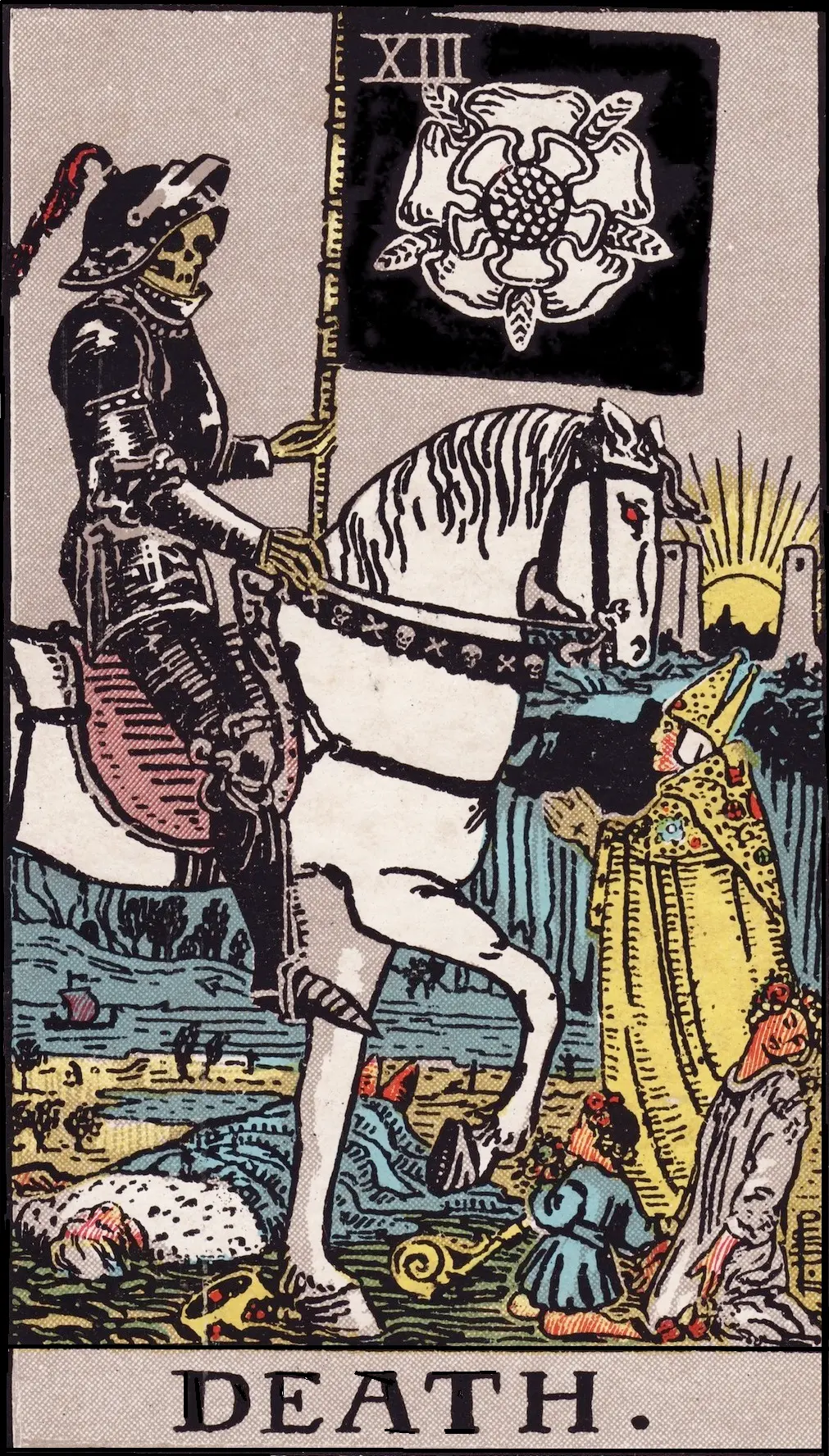
Major Arcana · XIII
Death
- transformation
- endings
- change
- release
- rebirth
- transition
- letting go
- metamorphosis
A skeleton in black armour rides a white horse across a barren field. A king lies fallen at his feet; a child looks up at him; a maiden turns her face away; a bishop stands and prays. In his hand he carries a black banner emblazoned with a white five-petalled rose. In the distance, between two pale towers, the sun is rising. Death is the most feared card in the deck, and almost never the most accurate fear. It does not announce the end of a life; it announces the end of a way of life — and the strange grace that arrives when something already-dead is finally allowed to fall.
Upright Meaning
General
Death is the great clarifier. It comes when something in your life has already been over for some time — a relationship that ended in spirit before it ends in fact, a career that stopped fitting years ago, an identity you have outgrown but kept dressing up in. The skeleton on the white horse is not coming to take from you; he is coming to make official what your soul has already accepted. The fall of the king on the card is the fall of the part of your old self that has refused to abdicate. Upright, Death is merciful. It allows the long-postponed ending to finally happen — and behind it, almost immediately, a new dawn begins to rise. To draw Death upright is to be told: the death you keep avoiding is the doorway you keep failing to walk through. Walk through.
Love & Relationships
In love, Death almost always describes the end of a relationship phase — not necessarily a breakup, but the death of the way you and your partner used to relate. For couples, this can mean the end of an old pattern (the constant fighting, the unspoken resentment, the parent-child dynamic) and the difficult, beautiful birth of a more honest one. For singles, Death often arrives at the moment you finally let go of a person you have been mourning — and only after that release does the new love become possible. The card is rarely about literal death; it is about the necessary endings that make space for the love your soul actually wants.
Career & Work
At work, Death is the role you have to leave, the project that needs to be killed, the company you have outgrown, the identity-as-professional that no longer matches who you have become. The card sometimes signals layoffs and restructurings, but more often signals the inner letting-go that precedes the outer change. The rising sun in the distance is the new work that cannot arrive until the old has been mourned and released.
Health & Well-being
For health, Death describes the end of a chapter — the end of an illness, the end of a destructive habit, the end of a self-image (the eternal-youth, the always-able body) that the body itself has stopped supporting. The card recommends grief as medicine. What dies in us must be wept for, or it lingers as ghost. After the grief, the dawn.
Spirituality
Spiritually, Death is the great teacher. Every tradition that has anything to teach about awakening teaches that the false self must die before the true one can be born. The card invites you, gently, into that work: to die before you die, as the mystics say, so that you may live before you live.
Reversed Meaning
General
Reversed, Death describes resistance to a needed ending — clinging to a relationship that ended months ago, a job that ended in spirit years ago, an identity that has stopped fitting. The card warns that what is refused does not stop dying; it just dies more painfully. Sometimes the reversal also describes the long, drawn-out, half-finished ending — the breakup that keeps ending, the resignation never finally tendered, the slow leak rather than the clean cut. Either way, the card asks for the courage to finish what is finished.
Love & Relationships
Reversed in love, Death describes relationships that should have ended and have not — the on-again, off-again that drains both people, the marriage that is held together by inertia rather than love, the situationship that refuses to define itself. It can also describe the extended grief after a breakup, the inability to let go. The card invites you to let what is already gone, finally, be gone.
Career & Work
Reversed at work, the card warns of staying too long — in industries that are dying, in roles that have stopped feeding you, in identities that have stopped fitting. The longer you stay past your time, the harder the eventual leaving becomes.
Health & Well-being
Reversed, Death describes stagnation — patterns that are slowly killing you that you keep choosing anyway: the relationship that drains, the substance that anaesthetises, the routine that erodes. The card asks you to choose, today, to stop choosing what is already over.
Spirituality
Reversed, the card describes the spiritual chapter you have outgrown but cannot bring yourself to leave — the teacher, the community, the framework that no longer matches your actual experience. Be brave enough to admit when something has done its work.
Symbolism & Imagery
The white horse Death rides is the same colour as resurrection — what looks like the colour of mourning in this card is actually the colour of arrival. The black armour is grief, dignified and ceremonial. The white five-petalled rose on the banner is the rose of beauty and rebirth, an old emblem of the spring that follows winter. The four figures on the ground are the four responses humans typically have to mortality — the king who refuses (and falls), the bishop who prays, the maiden who looks away, the child who looks directly at Death without fear. The rising sun between the two pillars at the horizon is the entire point of the card: this is the dawn, not the dusk. Through the door of Death walks the new life.
History & Tradition
Death has appeared in the deck since the earliest Italian tarots, often as a numbered but unnamed card — too taboo to label. Some Marseille decks left the figure deliberately ambiguous, so the user could decide whether to name him or not. Across centuries of esoteric reading, the consensus has held: this card is almost never literal. It is the great metamorphosis card, the door between two phases of a life. The Rider–Waite–Smith deck of 1909 made the rising sun explicit on the horizon — Pamela Colman Smith's gentle insistence that this card is not the end.
Numerology
Death is Thirteen — a number long associated with transformation in Western tradition (the lunar months, the thirteenth guest, the hidden disciple). One plus three equals four (1+3=4), the number of foundation: when one structure dies, the foundation for the next is laid. Thirteen is not unlucky; it is the number of the threshold.
Advice from the Card
Let it end. The thing you are trying to keep alive is keeping you from the next thing. Mourn it properly — and then, when the grief has done its work, look up. The sun is rising.
Yes or No?
It depends what you are asking. If you are asking whether the old situation will continue, the answer is no. If you are asking whether the new one will come, the answer is yes — but only after the ending.
Ready for a Reading?
When a card from the library catches your attention, the cards may already be speaking. Pull one yourself and ask a question — your answer is one click away.
Ask the Tarot a Question