Major Arcana · IV
The Emperor
- authority
- structure
- leadership
- stability
- fatherhood
- discipline
- control
- foundation
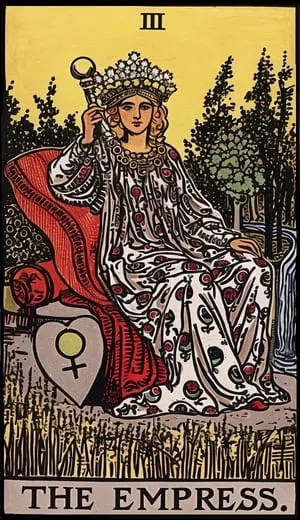
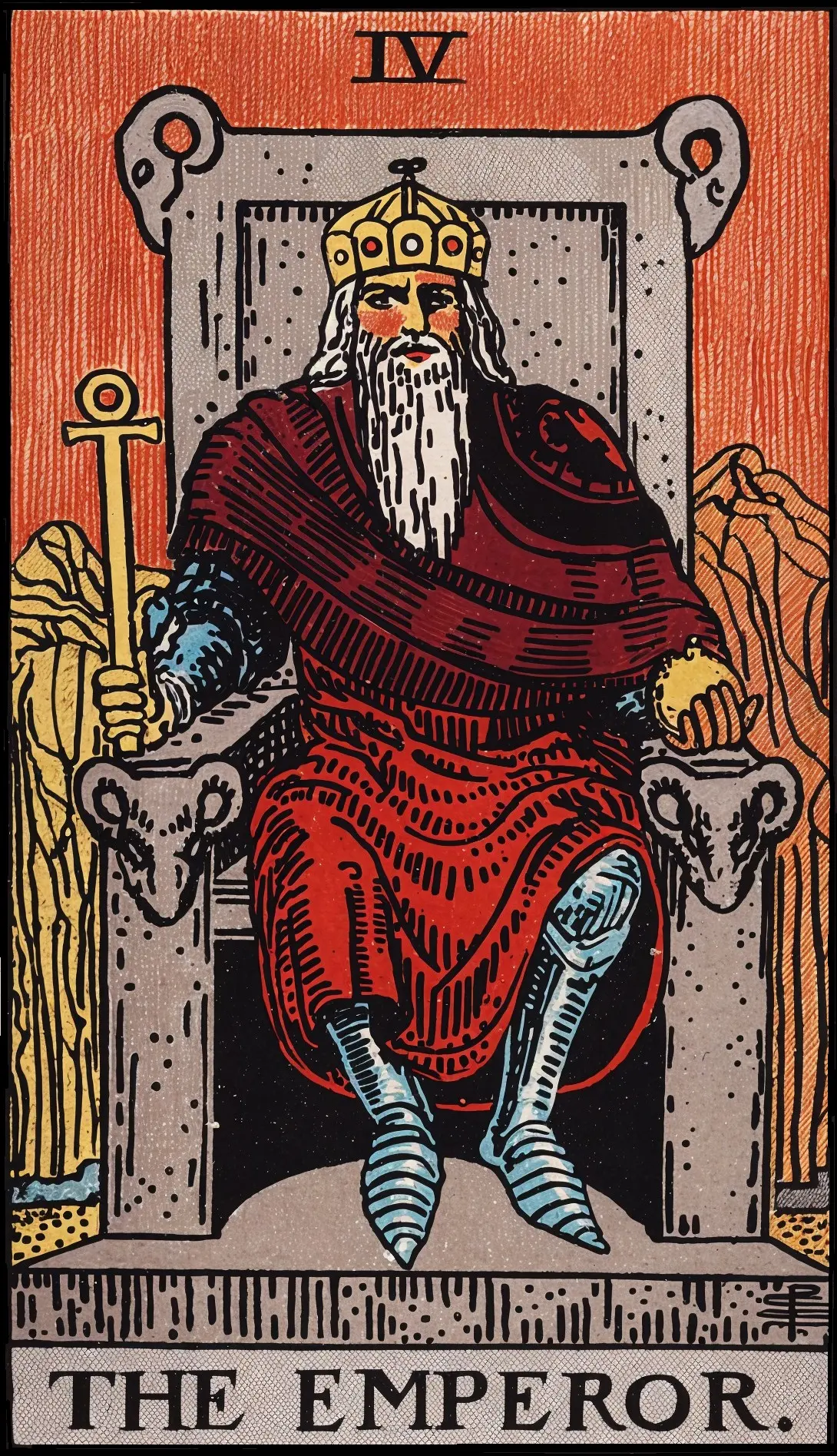
The Emperor sits squarely on a stone throne, the rams of Aries carved into its corners. He wears armour beneath his robe; in one hand he holds an ankh-headed sceptre, in the other a globe of dominion. Behind him rise dry, stark mountains. He is the principle of order — the one who sets a boundary, builds a frame, and defends the structure inside which life can grow. Where the Empress is the green field, the Emperor is the wall around the field that keeps it from being trampled.
Upright Meaning
General
When the Emperor arrives, life is asking for structure. There is something in your situation that needs a clear decision, a defined boundary, a written plan, an actual leader. The card is not glamorous; it is the unsung work of finishing what was begun. The Emperor is the friend who reminds you to set up the legal structure, write the contract, schedule the meeting, do the spreadsheet. He is also the inner father — the part of you that can hold a 'no' without apologising, can set a limit and keep it, can take responsibility for an outcome rather than waiting for someone else to.
Love & Relationships
In love, the Emperor is commitment, stability, the partner who shows up week after week. For singles, he often signals an older or established person, or a relationship that asks you to be more grown-up than you have been. For couples, he is the moment to define what you are: discuss money, agree on rules, name the future. The card doesn't sing; but the love it describes does not collapse the first time it meets a real difficulty.
Career & Work
At work, the Emperor is leadership and structure. He often appears around promotion, taking responsibility for a team, founding or taking charge of a project. He is also the card of strategy, planning, regulation, governance — anywhere a clear chain of authority is required. If you are an early-career creative, he is the boring discipline that is about to make your wild talent actually pay. If you are senior, he asks: are you using your authority well, or are you abdicating it?
Health & Well-being
For health, the Emperor is consistency. Routine, scheduled appointments, the unromantic work of doing the same useful thing every day. He often appears when a body is asking for boundaries — limits on work hours, on screen time, on what you allow into your week. The medicine is structure.
Spirituality
Spiritually, the Emperor is a tradition with rules, a daily practice you can rely on. Not the most ecstatic card, but the one that builds the chapel where the ecstatic moments can later happen. Form is grace's home.
Reversed Meaning
General
Reversed, the Emperor's order tips into rigidity or domination. Sometimes the meaning is a heavy-handed authority figure — a boss, a parent, a partner who confuses control with care. Sometimes it is the absence of structure — chaos, missing leadership, no one willing to make the call. The card asks where, in the situation, structure has either calcified or collapsed, and what one fair decision would restore both backbone and breath.
Love & Relationships
Reversed in love, the Emperor can describe a controlling, unavailable, or emotionally cold partner — or the wound of a father whose love had to be earned. It can also describe relationships where no one ever defines the relationship, leaving everyone unsure. Be honest about what you need, including, sometimes, more or less authority.
Career & Work
Reversed at work, the Emperor warns of micromanagement, bureaucracy, an autocratic culture, or — at the other extreme — leaderless drift. Speak up where you can; structure where you can; if neither is possible, plan an exit.
Health & Well-being
Reversed, the Emperor's discipline turns punishing: extreme regimens, white-knuckled control, ignoring the body's clear protests. Soften.
Spirituality
Reversed, the Emperor describes the dogma that forgot why it began. Honour the form, but remember it is not the point.
Symbolism & Imagery
The four ram heads on the throne are Aries, the cardinal fire sign — initiative, decisive action, the leader. The Emperor's sceptre is shaped like an ankh, the Egyptian symbol of life: his authority is meant to be life-giving, not death-bringing. The globe in his other hand is dominion. His armour shows beneath his robe: a king who rules from a soft body alone is a king who has not yet been tested. Behind him are stark mountains — the dry, structured world he has mastered. The river behind him is small, almost hidden — the inner life is present but does not run his decisions. He is the conscious will made into a chair.
History & Tradition
The Emperor has been the partner card to the Empress since the earliest decks of fifteenth-century Italy. In Marseille tradition he is shown in profile, holding a sceptre, sometimes with one leg crossed in a posture of relaxed power. The Rider–Waite–Smith Emperor faces the viewer head-on, more austere, more deliberately archetypal: the cosmic principle of order itself, no longer just a particular medieval king.
Numerology
The Emperor is Four — the number of foundations: four corners of a building, four cardinal directions, four legs of a stable table. Four is the structure that holds everything else up. It is not the most exciting number; it is the most necessary one. The Emperor's wisdom is the wisdom of the load-bearing wall.
Advice from the Card
Decide. Make the rule. Honour the boundary. Stop waiting for permission to lead the situation you are already in charge of. The Emperor's medicine is plain: take responsibility for the outcome, set the structure, and stand inside it.
Yes or No?
Yes — provided you are willing to stand by it. The Emperor agrees with commitments that are real and structures that hold weight.
Ready for a Reading?
When a card from the library catches your attention, the cards may already be speaking. Pull one yourself and ask a question — your answer is one click away.
Ask the Tarot a Question