Major Arcana · V
The Hierophant
- tradition
- teaching
- mentor
- religion
- ritual
- shared values
- conformity
- marriage
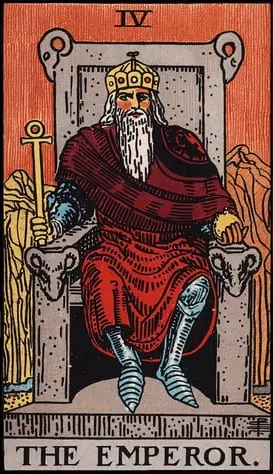
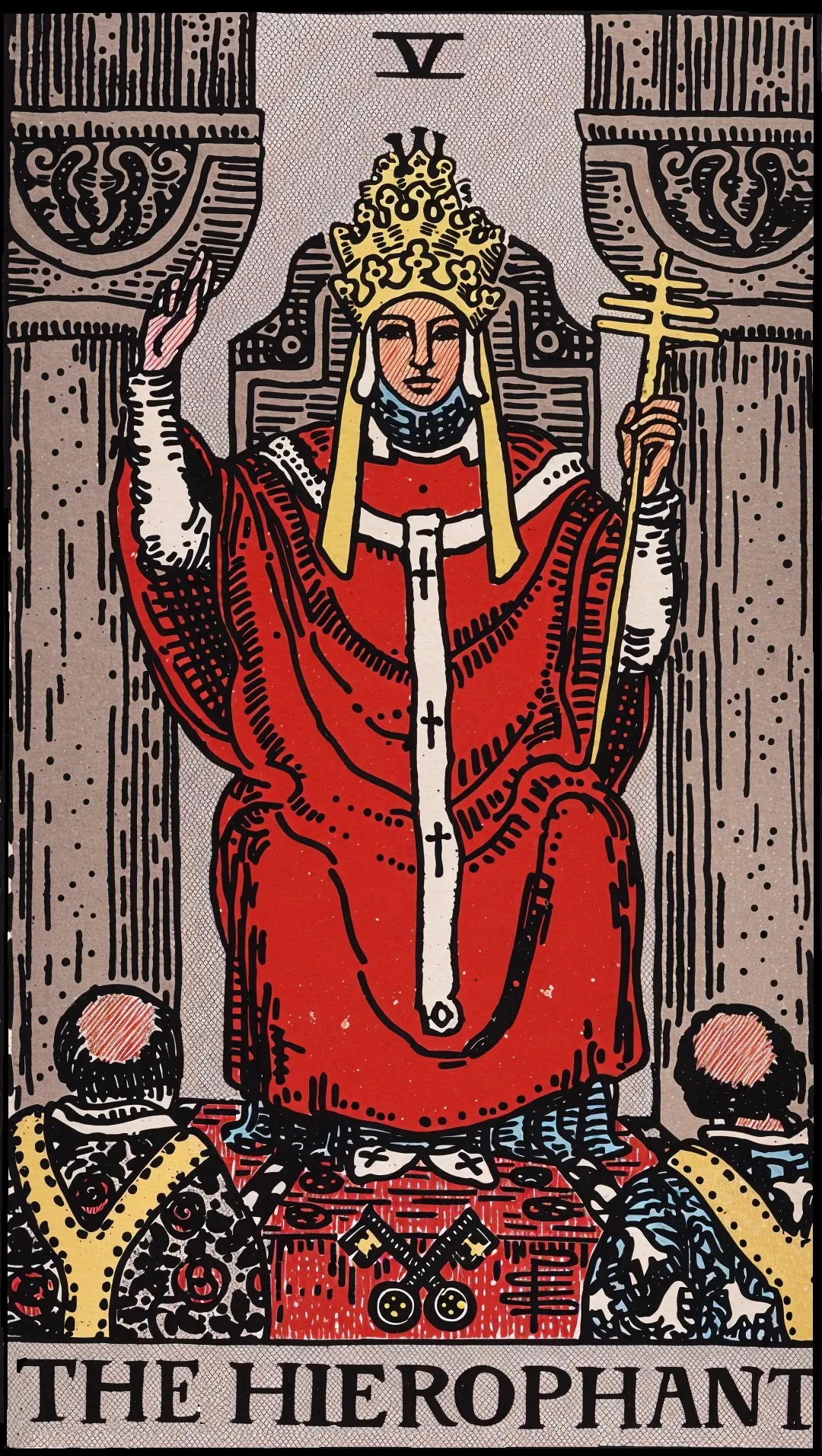
The Hierophant sits between two pillars in a temple, two acolytes kneeling at his feet, two crossed keys at the base of his throne. He raises his right hand in benediction; the left holds a triple-cross sceptre. He is the priest, the teacher, the keeper of the tradition: the one who passes wisdom down from the people who came before to the people who come after. Where the Emperor builds the secular order, the Hierophant builds the sacred one.
Upright Meaning
General
When the Hierophant arrives, you are being invited into something larger than yourself. Sometimes the meaning is a teacher, mentor, or institution you are about to learn from — a school, a faith, a craft tradition, a long apprenticeship. Sometimes it is the opposite invitation: to recognise that you have become the person someone else can learn from. The card honours rituals and ceremonies — weddings, graduations, vows of all kinds. It says that some forms of wisdom are not yours to invent; they have to be received.
Love & Relationships
In love, the Hierophant is the relationship that takes its place in a community: meeting the family, the wedding, the moving-in, the public commitment. For singles, he often signals a partner from a similar background, or someone you meet through traditional channels. For couples, he is the conversation about marriage, children, faith, shared values — the questions that turn a private love into something visible.
Career & Work
At work, the Hierophant is education, mentorship, or institutions. He often appears around teaching, training, certification, or work within established organisations: universities, religious bodies, healthcare, law, government. He is also the card of the apprentice who chooses a master to learn from rather than figuring it all out alone. If you are early in your career, he asks: who is the person whose work you want yours to resemble?
Health & Well-being
For health, the Hierophant favours conventional medicine, established protocols, second opinions from respected practitioners. He is also the body's wisdom encoded in tradition — the slow remedies of grandmothers, the rhythms of seasons. Where you are uncertain, ask someone who has done this many times before.
Spirituality
Spiritually, the Hierophant invites you into a tradition. The card honours the depth of practising within a lineage — a faith, a sangha, a coven, a school — rather than always inventing the spiritual life from scratch. There is great freedom in form.
Reversed Meaning
General
Reversed, the Hierophant turns from teacher into gatekeeper. Sometimes the meaning is a tradition that has become hollow — rules without spirit, dogma that punishes questions. Sometimes the opposite — a healthy refusal to follow a path you've outgrown, the moment when your own truth diverges from what you were taught. Both are the same task: to know whose voice you are obeying and whether it still serves you.
Love & Relationships
Reversed in love, the Hierophant can describe a relationship pressured by family expectation, religious rules, or social conformity. It can also describe two people deciding to live their love in a non-traditional way — and being right to. Honesty about what you actually want matters more than what should be wanted.
Career & Work
Reversed at work, the Hierophant warns of bureaucratic stagnation, institutions that have lost the plot, or meaningless certifications. It can also signal the moment to leave a profession that no longer fits your values, even though it has been your identity.
Health & Well-being
Reversed, the card may describe medical advice that does not feel right — get a second opinion. Or it may invite alternative practices the conventional system has dismissed too quickly.
Spirituality
Reversed, the Hierophant says the form has eaten the spirit. Question the rules. Or, conversely, return to the form having outgrown a long phase of rebellion.
Symbolism & Imagery
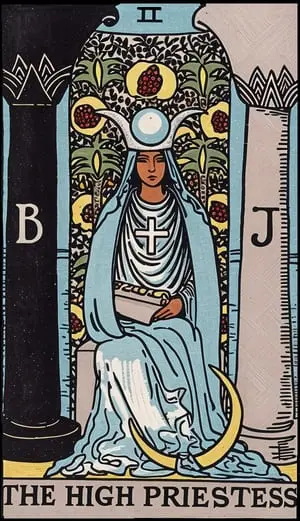
The Hierophant's triple-tiered crown represents the three worlds — physical, mental, spiritual — over which his teaching has authority. The triple-cross sceptre echoes the same idea. The two crossed keys at the base of his throne are the keys of the heavens and the earth: he holds the right to bind and to loose. The two acolytes at his feet are the next generation: one wears the lily (purity of intention), the other the rose (the heart). The two pillars are pillars of the temple, marking the threshold between profane and sacred space. His right hand makes the gesture of benediction — two fingers up to heaven, two folded down: the descent of grace through teaching.
History & Tradition
The Hierophant was originally 'The Pope' in Italian decks, paired with the High Priestess (originally 'The Popess') as the dual spiritual authorities. The Marseille tradition kept the title; the Rider–Waite–Smith deck of 1909 changed it to 'The Hierophant' (Greek: 'one who reveals sacred things') to broaden its symbolism beyond Roman Catholicism. Waite's intent was to keep the figure as a universal archetype: the priest of any tradition, the keeper of any lineage of meaning.
Numerology
The Hierophant is Five — the number of human reach. Four is the foundation; Five is the human being who lives on it, hands and head extended, asking questions. Five is the point of choice and instruction, the moment when the established order meets a person who wants to know it. The Hierophant's number is the number of the seeker's question and the teacher's answer.
Advice from the Card
Find a teacher, or be one. Honour the rituals that mark the threshold you are crossing. If a tradition feeds you, drink from it; if it has stopped feeding you, leave it kindly. Some wisdom you must invent; most you should inherit.
Yes or No?
Yes — particularly to commitments, ceremonies and choices that align you with values larger than yourself.
Ready for a Reading?
When a card from the library catches your attention, the cards may already be speaking. Pull one yourself and ask a question — your answer is one click away.
Ask the Tarot a Question