Minor Arcana · Cups
Five of Cups
- grief
- loss
- mourning
- regret
- sorrow
- healing
- perspective
- what remains
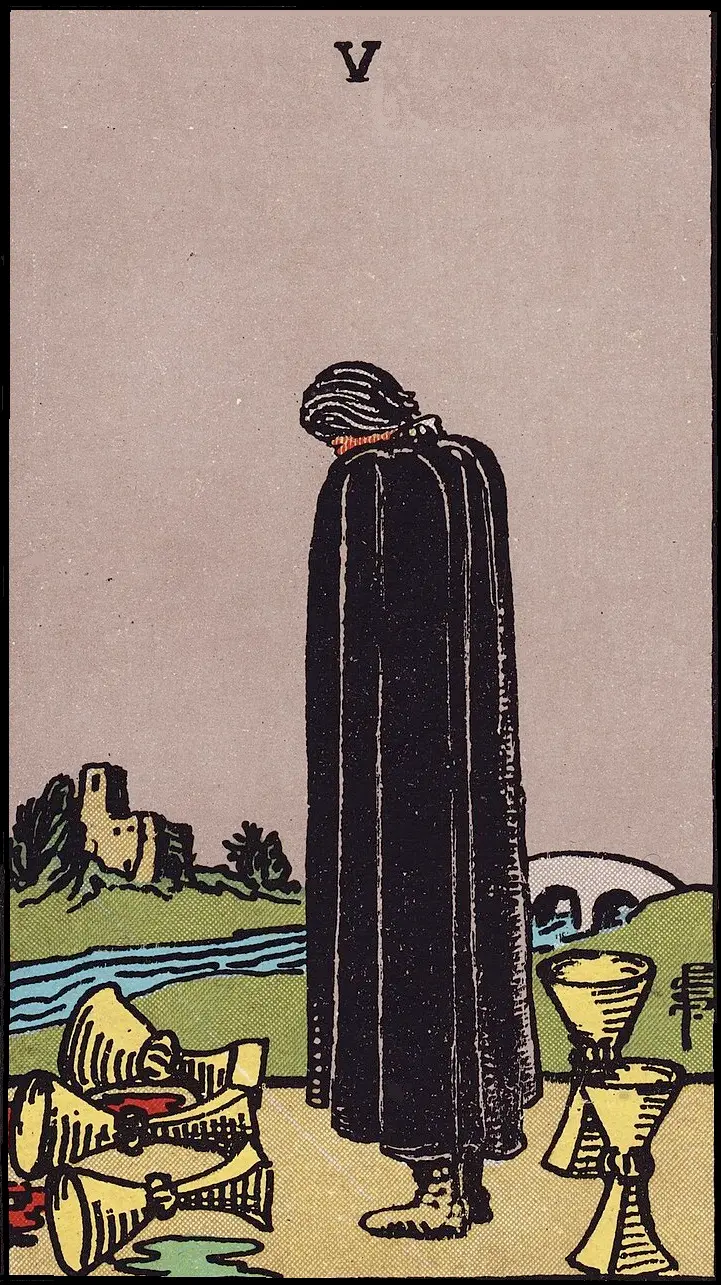
A figure in a long black cloak stands on a barren stretch of ground, head bowed, looking down at three cups that have fallen and spilled their wine. Behind him, two cups still stand upright, untouched. In the distance, a river runs past a small bridge that leads to a stone house. He cannot see the standing cups, the bridge, the home — only the spill in front of him. The Five of Cups is the card of grief and of the harder mercy that grief is hiding from view.
Upright Meaning
General
The Five of Cups arrives in the seasons of loss. The card does not deny the loss; the spill is real, the wine is real, the grief is real. But the card asks, gently, that you eventually turn around. Two cups still stand. The bridge home is not far. The river still runs. Grief has its time and its work, and the card honours that. But it also reminds you that the whole world has not ended, even when it feels that it has — and that the path back to a full life begins the moment the eyes finally lift from what was lost. To draw the Five of Cups upright is to be asked, with great tenderness, to look up when you are ready.
Love & Relationships
In love, the Five of Cups is heartbreak. The breakup, the betrayal, the disappointment of a relationship that did not become what you hoped. The card honours the mourning but reminds you, when the time comes, that you are still alive, still loveable, still capable of love. For couples in difficulty, it can describe a phase in which both partners are mourning what the relationship was rather than tending what it could still be — and the work is to turn together toward the cups still standing.
Career & Work
At work, the Five of Cups describes professional disappointments — the project that failed, the role that did not come through, the company that let you go. The card asks for an honest grief and then, eventually, for the resilience to look at what remains. Two cups still stand: skills you still have, contacts who still believe in you, work still possible. The path is not as bare as it first appears.
Health & Well-being
For health, the Five of Cups describes the emotional weight of illness or loss settling into the body — depression after a diagnosis, grief after the death of a loved one, sadness that is more physical than psychological. The card recommends grief work — therapy, support groups, the deep slow medicine of letting the wine finish spilling so that the cups still standing can be poured again.
Spirituality
Spiritually, the Five of Cups is the lesson of impermanence delivered as personal experience. Whatever has been lost, the soul has found that it can survive the loss. The cups have spilled, and you are still here. This is not a small fact. It is, in many traditions, the foundation of every other spiritual realisation.
Reversed Meaning
General
Reversed, the Five of Cups describes the moment of turning — the eyes lifting from the spilled wine, the recognition of what remains, the first willingness to walk back over the bridge toward home. The card is hopeful: grief is loosening its grip. Or, less hopefully, the reversal can describe stuck grief — sorrow that has become identity, loss that has been wrapped around for so long that it cannot be set down. Both meanings ask the same question: where are you now in the long work of mourning?
Love & Relationships
Reversed in love, the card describes healing after heartbreak — the realisation that you are, in fact, going to be fine; the new attraction beginning to stir; the friendships that carried you through becoming visible. It can also describe forgiveness, both of others and of self.
Career & Work
Reversed at work, the card describes the recovery from setback — the new role found, the lessons of the failure integrated, the willingness to try again. The cups are being refilled.
Health & Well-being
Reversed, the Five of Cups describes emerging from depression, recovery from a difficult diagnosis, the body becoming, again, hospitable. It can also warn against staying in mourning beyond what the body can sustain — chronic grief asks for help.
Spirituality
Reversed, the card describes the soul that has finished mourning what was, and is ready to be present to what is. Acceptance is a form of arrival.
Symbolism & Imagery
The black cloak is the dress of mourning, full and concealing — grief that has covered the whole figure. The three spilled cups are losses; their spilling onto barren ground is the way grief makes the world feel desolate. The two upright cups behind him are everything that has not been lost — and his inability to see them is the central fact of grief. The river running past is time, still moving, indifferent to and supportive of his sorrow. The bridge to the house is the path back to ordinary life, waiting for whenever he is ready to walk it.
History & Tradition
The Five of Cups in earlier tarots often showed simply five cups in arrangement, sometimes with a figure holding or contemplating them. The Rider–Waite–Smith image of the cloaked mourner with spilled cups is one of Pamela Colman Smith's great contributions, transforming a number card into a psychologically complete vignette of grief.
Numerology
The Five is the number of disruption, of the disturbance that follows the Four's stable structure. In every suit, the Five marks the crisis: the Five of Pentacles is poverty, the Five of Swords is conflict, the Five of Wands is rivalry. In the Cups, the disruption is loss — the disturbance not of body or status but of feeling.
Advice from the Card
Grieve fully. Then, when you can, turn around. The cups still standing are real. The bridge is not far.
Yes or No?
Probably not — and the question may be coloured by recent disappointment. Wait until you can see the whole picture.
Ready for a Reading?
When a card from the library catches your attention, the cards may already be speaking. Pull one yourself and ask a question — your answer is one click away.
Ask the Tarot a Question