Minor Arcana · Swords
Five of Swords
- conflict
- hollow victory
- win at all costs
- defeat
- betrayal
- dishonour
- costly battle
- ego
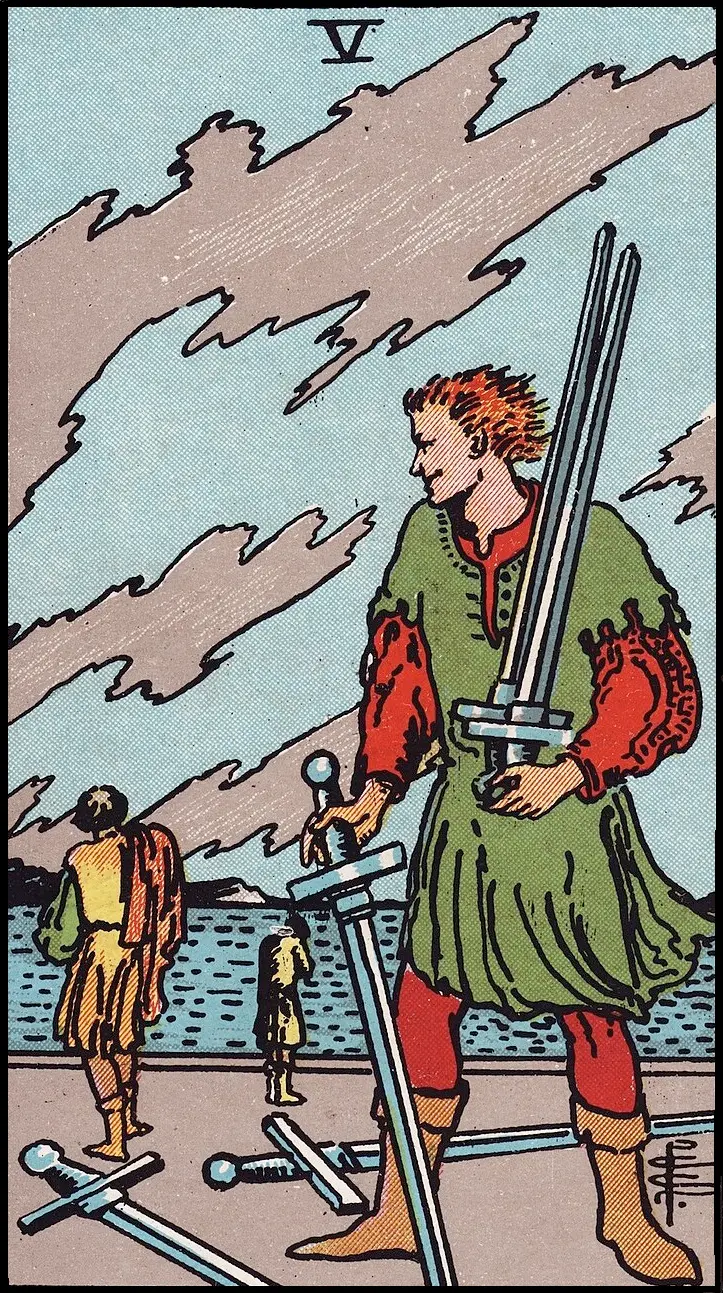
A young man stands triumphant in the foreground, three swords in his hands and two more lying at his feet. He has won. But behind him, two other figures walk away in defeat, heads bowed against an angry sky scattered with broken clouds. His grin is not quite victory — it is closer to spite. The Five of Swords is the card of the hollow win, the conflict in which what was won was less than what was lost.
Upright Meaning
General
The Five of Swords arrives in the seasons of conflict that should have been avoided. The card does not deny that someone has won; the swords are clearly in his hand. But the win has cost the relationships, the trust, the honest standing among peers. The figures walking away are the friends, partners, and allies who could not stay through this kind of victory. To draw the Five of Swords upright is to be asked, while there is still time, whether the win is worth it. Sometimes it is — some battles must be fought. But often the deeper victory is the willingness to lose the small fight in service of the larger relationship.
Love & Relationships
In love, the Five of Swords describes the argument that no one really wins. The partner who insists on being right at the cost of the connection, the family fight that has alienated the relatives, the breakup conducted with cruelty. The card asks honestly: was being right worth being alone?
Career & Work
At work, the Five of Swords is the colleague who wins at the cost of team trust, the negotiation conducted as zero-sum, the professional victory that ends in burnt bridges. Sometimes the card describes being on the losing side of such a conflict — leaving with dignity, knowing the winner has not actually won.
Health & Well-being
For health, the Five of Swords describes stress from interpersonal conflict — the body bearing the cost of arguments that should have been let go, the chronic tension of being right.
Spirituality
Spiritually, the Five of Swords is the lesson of ego in conflict. The win is real on the surface; underneath, something has been lost. Some traditions call this karma; others call it character. Either way, the card invites a different kind of strength — the strength to lay the swords down.
Reversed Meaning
General
Reversed, the Five of Swords can describe reconciliation beginning — the willingness to apologise, to repair, to put down the weapons that should not have been picked up. Or it can describe escalation — the hollow victory hardening into permanent rupture. The card asks where you are in the cycle.
Love & Relationships
Reversed in love, the card describes the apology finally given, the partner finally willing to listen, the conflict finally being released. Or, less hopefully, the relationship that has gone past saving.
Career & Work
Reversed at work, the card describes professional reconciliation — the burnt bridge unexpectedly rebuilt, the rivalry softening into respect. Or the recognition that the workplace conflict has become unwinnable.
Health & Well-being
Reversed, the card describes recovery from stress-related illness as conflict resolves. Or, less helpfully, the deepening of conflict-related health problems.
Spirituality
Reversed, the card describes the willingness to let go of being right, to pick up humility instead of swords.
Symbolism & Imagery
The young winner's grin is the card's most uncomfortable detail — not joy but smugness, not triumph but spite. The three swords in his hand and two at his feet are the means by which the win was achieved — clear thinking weaponised. The retreating figures are the cost of the win. The sky with its jagged broken clouds is conflict's mood. The water in the background is the calm that the conflict has disturbed.
History & Tradition
Earlier decks showed five swords in arrangement; the Rider–Waite–Smith image of the spiteful winner and the retreating losers is Pamela Colman Smith's narrative invention, fixing the card's modern association with hollow victory and the cost of winning badly.
Numerology
The Five is the number of disruption, of crisis. In the Swords, the disruption is intellectual and interpersonal — the conflict that fractures relationships, the argument that breaks something that was working.
Advice from the Card
Lay down the sword. Even if you are right. The win that costs the relationship is not, in the end, the win you came for.
Yes or No?
No — and the path involves more conflict than is worth it. Reconsider what you actually want.
Ready for a Reading?
When a card from the library catches your attention, the cards may already be speaking. Pull one yourself and ask a question — your answer is one click away.
Ask the Tarot a Question