Minor Arcana · Swords
Six of Swords
- moving on
- transition
- journey
- escape
- healing passage
- leaving behind
- calmer waters
- recovery
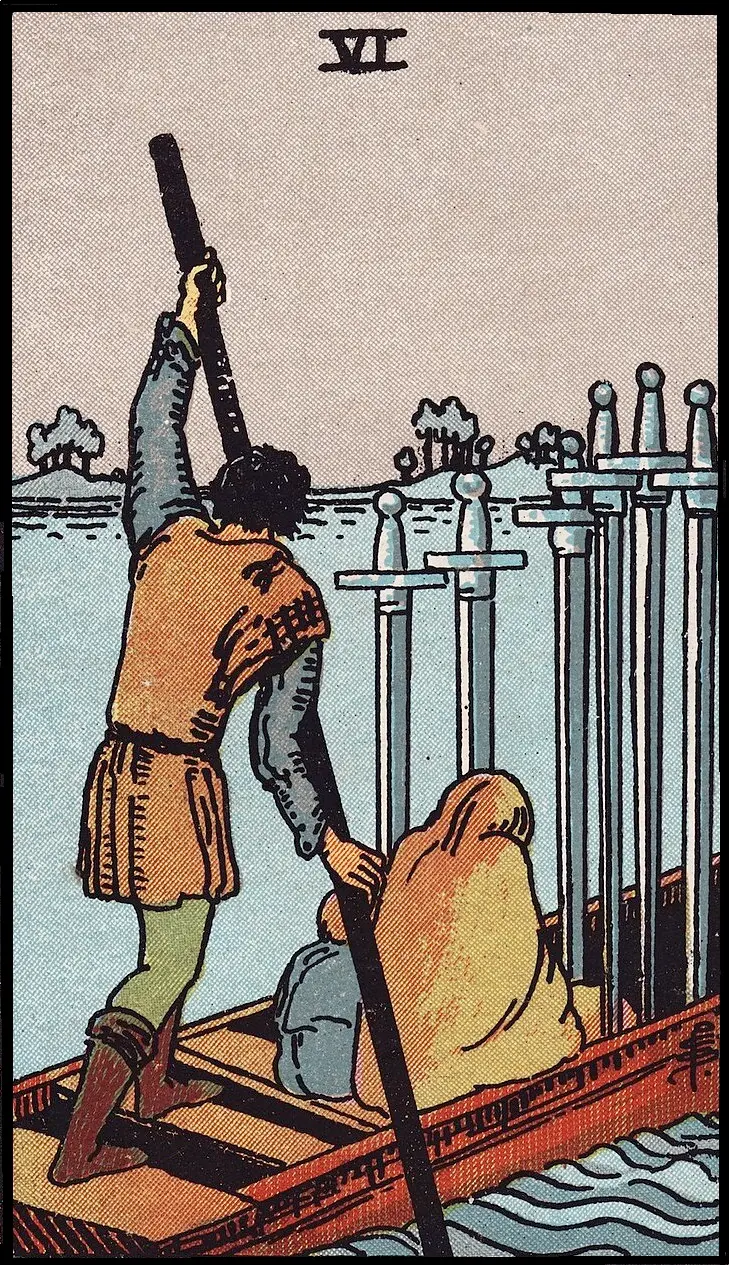
A ferryman poles a small boat across grey water toward a distant shore. In the boat sit a hooded woman and a small child, six swords planted upright in the bow. The water on the near side of the boat is choppy; on the far side, calm. Neither figure looks back. The Six of Swords is the card of the journey out of difficulty — the passage from where you have been to a quieter place, with the pain of the past carried, but no longer leading.
Upright Meaning
General
The Six of Swords arrives at the moments when the worst of a difficult chapter is, finally, behind you. The card honours both the journey and the difficulty — the swords in the bow are not denied, the water has been turbulent — but it points toward the calm shore that is now visible. The ferryman is steady, methodical, taking the small family across one stroke at a time. To draw the Six of Swords upright is to be reassured that you are, indeed, moving — and to be invited not to look back too often. The shore ahead is real, even if it is still far away.
Love & Relationships
In love, the Six of Swords describes leaving difficult relationships behind — the breakup whose worst is over, the marriage being lovingly ended, the family pattern finally broken. For couples, it can describe coming through a hard chapter together — the worst of the conflict resolved, the way forward becoming visible.
Career & Work
At work, the Six of Swords describes career transitions — leaving the difficult job for a calmer one, recovering from professional setbacks, the slow rebuilding after a bad period. The card supports honest movement away from what is not working.
Health & Well-being
For health, the Six of Swords describes recovery in transit — the body slowly improving, mental health stabilising, the long passage between illness and full health. The card recommends patience with the journey.
Spirituality
Spiritually, the Six of Swords is the soul moving from one chapter of the inner life to the next — leaving behind the dark wood of a long difficult season, heading for a quieter shore. The journey is real; the swords are still there; but the destination is becoming visible.
Reversed Meaning
General
Reversed, the Six of Swords describes the journey not being made — the inability to leave a difficult situation, the refusal to move on, the looking-back that prevents arrival. It can also describe difficult travel literally — delays, complications, journeys interrupted.
Love & Relationships
Reversed in love, the card describes the inability to fully leave a relationship that has ended, the constant returning to the ex, or the partnership that should have ended but has not.
Career & Work
Reversed at work, the card describes careers held on to past their time, transitions delayed, the move that has been postponed for too long.
Health & Well-being
Reversed, the card describes recovery stalled, the patient unable to move past the trauma, healing that has not progressed despite time.
Spirituality
Reversed, the card describes the soul stuck mid-passage, unable to commit to the next chapter.
Symbolism & Imagery
The ferryman is the steady hand of the transition — someone or something carrying you when you cannot carry yourself. The hooded woman and child are the most vulnerable parts of the self, being carried to safety. The six swords in the bow are the difficulties carried with you — not left behind entirely, but no longer leading. The water that is choppy near and calm farther is the journey's middle: not yet at the destination, no longer at the start.
History & Tradition
Earlier decks showed six swords in arrangement; the Rider–Waite–Smith image of the ferry crossing is Pamela Colman Smith's contribution, fixing the card's modern association with the journey through difficult waters.
Numerology
The Six is the number of harmony after the Five's crisis. In the Swords, this harmony is in motion — the journey itself is the harmonising. Recovery is not a place; it is a passage.
Advice from the Card
Keep moving. The shore is real. Do not look back so often that you forget you are crossing.
Yes or No?
Yes — but the yes involves a transition. Be ready for movement before deciding.
Ready for a Reading?
When a card from the library catches your attention, the cards may already be speaking. Pull one yourself and ask a question — your answer is one click away.
Ask the Tarot a Question